
Bristol weekend jump-start call-outs — what to expect
 Tue, 02/Sep/2026
Weekend jump starts in Bristol
Saturday in Clifton or Sunday near Harbourside differs from a Wednesday commute. Hazards on. Stay with the car. On Gloucester Road residents’ bays, name a café or side street so the van is not lost in Stokes Croft one-ways. Weekend flats often follow Friday night centre hops with heaters on, then a cold sit until late morning.
Cabot Circus decks and harbourside parks add barrier timing when retail hours differ from your exit. Tell security early. Hills toward Totterdown and Bedminster need firm brakes on frost. One clean crank, accessories off.
Why weekends expose soft batteries
Southville micro-commutes barely charge cells. Friday near Broadmead plus a Saturday lie-in ends in a no-crank. Stop-start warnings ignored all week become driveway failures.
- Kill chargers before the last attempt.
- Note Cabot Circus level and colour zone.
- What3Words helps harbourside weak signage.
- Mention diesel if relevant.
Weekend access quirks
Bridge closures, harbour events, Ashton Gate spill change routes. Narrow Clifton terraces may need the van short of your bumper with hazards. Skip random nightlife jump offers — wait for a booked technician. Keep ANPR tickets valid and children belted in busy retail aisles.
Roadside hazards while you are stuck
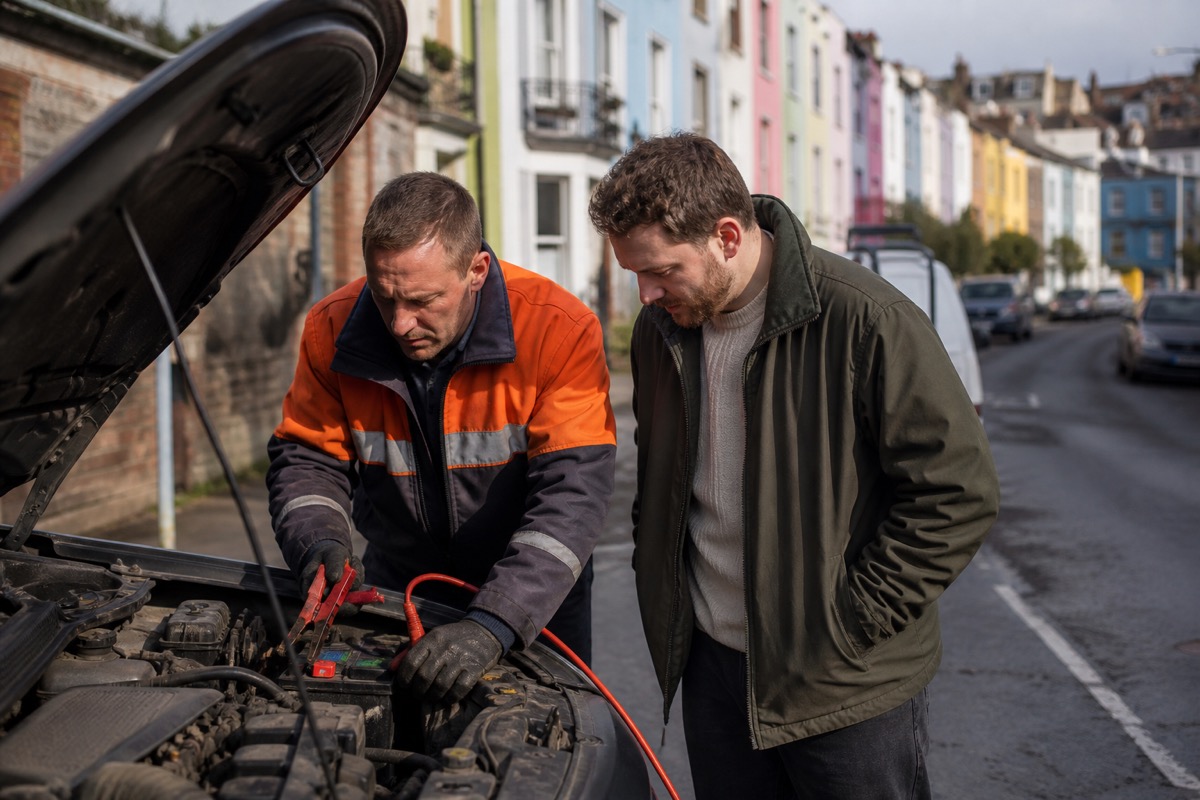
Weekend Harbourside crowds and Clifton terraces mean tight space — keep children belted and stand clear of bike flows.
Use hazard lights if they work. Stand on the pavement side, not in the live lane. Keep children and pets inside with belts on when traffic is close. High-vis in the boot is worth putting on if you must stand near moving vehicles. Do not stand behind the car on a dark road where you become the first thing a distracted driver hits.
If you are on a motorway or fast dual carriageway hard shoulder, follow National Highways guidance for your situation — often that means getting behind a barrier where possible and waiting for professional help rather than attempting DIY leads in live traffic. In ordinary streets and car parks the priority is visibility, locked doors when appropriate, and a clear location pin for the technician.
Quick checks before you assume the worst
Friday night Broadmead hops plus a Saturday lie-in often explain Sunday clicking better than a sudden starter failure.
Confirm the car is in Park or Neutral with the clutch depressed on a manual. Try the spare key if an immobiliser light is flashing. Look for obvious loose terminal clamps if you can see the battery without dismantling plastic covers. Do not probe unknown bright-coloured high-voltage cabling on hybrids — if in doubt, wait for the technician.
Headlights-on then crank: if they die completely, voltage is very low. If they stay bright but nothing cranks, you may be outside simple flat-battery territory. Rapid clicking with dimming lights still points to power. Smell and visual checks matter: skip the jump when the case is cracked, swollen or stinks of sulphur.
How a mobile jump-start call-out usually works
Once you book, you should get a clear price confirmation and an ETA window. Stay reachable on the number you gave. If you move bay or street because security insisted, update the operator immediately so the technician is not searching the wrong deck.
On arrival the technician will typically meter the battery, inspect for obvious damage, then boost with a pack sized for the job. Good practice includes confirming polarity and keeping cables tidy in tight aisles. After a start, expect a short check that the engine keeps running and a plain recommendation: drive to recharge, test soon, or seek further diagnosis if something else is wrong.
You are not buying a membership product mid-roadside. You are buying attendance and a boost for a flat-battery symptom. If the job turns out not to be a battery, you should hear that without pressure to purchase unrelated recovery you did not ask for.
What to tell the operator (and what to have ready)
Weekend, symptom, Clifton or Cabot Circus landmark, level/bay, any harbour event closures you can see.
Have the registration, a clear symptom in one sentence, and whether the car is petrol, diesel or mild-hybrid assist. Mention stop-start if the badge is on the dash. If the battery looks swollen or smells of sulphur, say that before anyone connects clamps. Keep a power bank for the phone; cold and weak signal eat charge while you wait.
What3Words pinned to the exact bay or kerb space removes half the delay on first arrival. Photos of pillar signs, barrier height plates and gate keypads help when you cannot describe the warren accurately over traffic noise.
Illustrative UK jump-start call-outs often fall in the £49–£150 range depending on time, access and vehicle. Confirm the price before dispatch so the figure is fixed before anyone rolls. Local notes sit on the Bristol jump-start hub. Call 020 8088 4023 or use /quote when you want that confirmation in writing as well as on the phone. Wider illustrative bands across cities are on the UK jump-start pricing guide.
Scope stays jump-start focused. If a correct boost still leaves a silent crank or the engine dies within a few streets, you may need diagnosis or recovery through a provider you choose — that is a different job, said plainly, not dressed up as another boost.
While you wait
Narrow Clifton streets may need the van short of your bumper with hazards on.
Skip random nightlife jump offers — wait for the booked technician.
Keep the phone warm in an inner pocket — cold handsets die faster on the pavement. If you must leave the car briefly for signal, lock it and return as soon as you have one bar. Do not empty the cabin onto the tarmac while you wait; bags invite attention you do not need.
After the jump: rebuild the charge properly
Use freer sections when safe rather than shutting down after three minutes in Southville. Aim for 20–40 minutes of genuine running with the heater on a moderate setting rather than maximum. Short stop-start crawls barely replace what a deep discharge took out. Mixed speeds help the alternator more than a long idle in a car-park bay.
If the red charge lamp stays on, park somewhere safe and arrange a charging-system check the same day. Continuing with a warning light risks a second flat further from help. Book a load test within the week if the battery is more than about four years old, if stop-start has been unavailable for days, or if this is the second flat of the month.
Corroded terminals, loose earth straps and sticky boot lights are mundane villains. Ask the technician for a quick visual while the bonnet is open. Do not switch the engine off at the next corner after a deep flat just to grab a coffee — that habit creates another call-out before lunch. Get the charge back first, then run errands.
Prevention that actually changes outcomes
- Sidelight check after nights out.
- Save Cabot Circus attendant habits.
- Heed stop-start warnings all week.
- Pack if late finishes are common.
Weekends reveal weekday short-trip damage — fix the charge habit after the boost.
None of these habits require specialist tools. They do require treating the first lazy crank as useful information rather than bad luck. A battery that feels soft on a mild evening will not magically toughen up for a cold, wet morning with a full accessory load.
Are weekend ETAs longer?
They can be busier — book early and stay reachable on the number you gave.
Cabot Circus barriers?
Give level, colour zone and height limits; tell security if closing.
Drive time?
20–40 minutes of real running.
Harbour events blocking roads?
Tell the operator what you can see so routing adjusts.

